History of Turopolje
The Turopolje chronicle
The story of the podgutnica runs through old charters, cavalry uniforms and the red silk bows kept by the Museum of Turopolje.
Photographs from Touropolje and the City of Velika Gorica.
Antiquity to the 16th century
Land and charters
All periods-
1st-4th c.
Roman Andautonia
The Roman municipal center of Andautonia flourishes at present-day Ščitarjevo near Velika Gorica.
-
1225
Charter of Duke Bela
Duke Bela (later King Bela IV) elevates the ancestors of Turopolje's noble community to free noble status, preserved in King Matthias Corvinus's 1466 transcript.
-
1228
First mention of Velika Gorica
Velika Gorica is first recorded in surviving written sources as a parish seat.
-
1278-1279
First statute and assembly (spravišće)
At the Croatian Parliament in 1278, Ban Nikola codifies Turopolje customary law and privileges, confirmed by King Ladislaus IV in 1279.
-
1334 / 1530
Campus Turouo and the name Turopolje
Archdeacon Ivan Gorički records Campus Turouo in 1334; the Croatian name Turopolje appears in sources from 1530 onward alongside the older Latin Campus Zagrabiensis.
-
1368 / 1526
Turopolje Banderia on campaign
The earliest record of a POT soldier dates to 1368; 19 Turopolje fighters are documented killed at the Battle of Mohács in 1526. The unit fielded 120 to 400 horsemen and foot soldiers.
17th century to 1947
Under the banner
All periods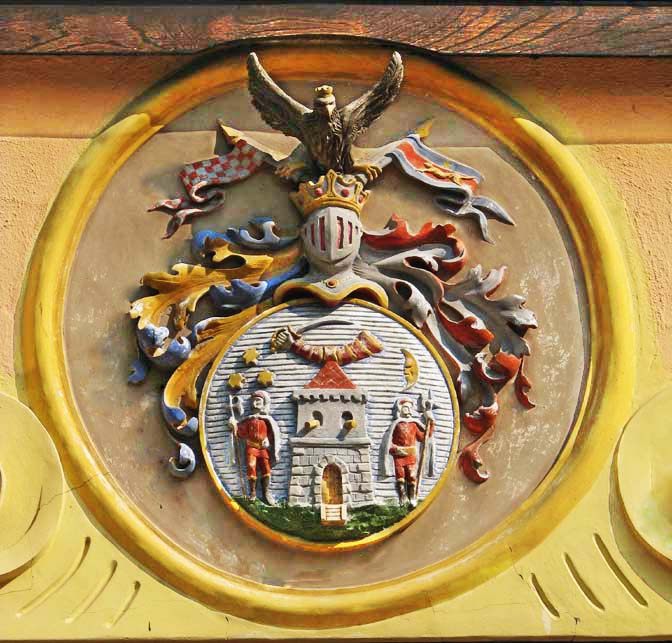

-
17th century
Croatian cavalry, Louis XIV, and the cravat
During the Thirty Years' War and in service to French King Louis XIV (reigned 1643-1715), Croatian cavalrymen wore knotted neckerchiefs. The French word cravate evolved from Cravates / Croates, and the Régiment Royal-Cravates was formed in 1667.
-
1737
Coat of arms and seal of POT
Emperor and King Charles VI grants the official coat of arms and seal of the Noble Municipality of Turopolje, whose stars and crescent later enter the modern arms of Velika Gorica.
-
1750 / 1765
Lukavec Castle and Turopolje Town Hall
Masonry reconstruction of Lukavec Castle finishes in 1750, followed by Turopolje Town Hall in Velika Gorica around 1765 (home of the Museum of Turopolje since 1960). The decorated civilian ribbon podgutnica emerges from the 18th century onward.
-
1848 / 1947
End of feudal service and post-war abolition
The Banderia takes part in its last historical military campaign in 1848. In April 1947, post-WWII authorities dissolve POT and nationalize its estates and oak forests.
1991 to 2025
A custom returns
All periods-
1991 / 1993
Civic restoration of POT and the Banderia
POT resumes civic activity in 1991, and on 24 April 1993 (St. George's Day) the Turopolje Banderia is ceremonially renewed as a founding member of the Alliance of Historical Units of the Croatian Army.
-
17-18 Oct 2008
Parliamentary proclamation of Cravat Day
The Croatian Parliament (Official Gazette 123/2008, item 3515) proclaims 18 October as Cravat Day in the Republic of Croatia.
-
2011-2025
Contemporary revival
Project "Turopolje i kravata" (2011), documentary film Turopoljska podgutnica (2012, text by Stjepan Šipušić Kazo), EXPO 2020 Dubai (2021-2022), Borboleta collection (2021), and 577 handmade podgutnice by Tina Miličević for Velika Gorica kindergartens (2025).

The uniform
The soldier’s red kerchief
At the throat of a Turopolje guardsman, a knotted red podgutnica rests against a white rubača embroidered with blue oak leaves and acorns. A fur-trimmed navy menten hangs from his left shoulder. Brass buttons, a black fur kuna cap, embroidered trousers and a ceremonial saber complete the uniform.
A married woman’s poculica carried a different message. Its lace and beads marked her place in the community. The museum preserves both garments as part of Turopolje dress.
In seventeenth-century France, the scarves of Croatian cavalrymen gave the cravat its name. In Turopolje, families tell the story through the podgutnica. The Noble Municipality traces its connection to the cravat through local textile traditions and the Banderia’s service in Europe.
Sources
- Croatian Encyclopedia Turopolje
- Croatian Encyclopedia The cravat
- Official Gazette 123/2008 Decision proclaiming Cravat Day in Croatia, item 3515.
- Noble Municipality of Turopolje Digital archive of historical studies
- Velika Gorica Tourist Board / Touropolje The Turopolje Banderia
- Museum of Turopolje The museum and its collections
- Zagreb County The Turopolje podgutnica exhibited in Dubai